

Can a 10 Minute Resistance Band Workout Really Tone You?
Last Updated: November 14, 2026
Quick Summary
A 10 minute resistance band workout works because short, focused sessions beat long ones you skip, and ten minutes of band training fits between meetings and school runs so you actually do it. The plan runs 1 minute warm-up, 8 minutes of circuit work, and 1 minute cool-down.
- The circuit is two rounds of four exercises at 40 seconds work and 20 seconds rest.
- The four moves are squat, pull-apart, split squat and shoulder press.
- Beginners should use a light-to-medium band and slow the tempo to two seconds each way.
- Never use a band with nicks, tears or a faded surface, and check it before every session.
- The most common mistake is miscounting rounds and rest, which stretches the session past ten minutes.
Table of Contents
- Why a 10 Minute Resistance Band Workout Works
- The Full Body Workout Resistance Band Plan: Minute by Minute
- A 10 Minute Resistance Band Workout for Beginners
- Your 10 Minute Resistance Band Workout at Home
- Get the 10 Minute Resistance Band Workout PDF and Stick With It
- Start Your First 10-Minute Band Session Today
- Frequently Asked Questions
Why a 10 Minute Resistance Band Workout Works
A 10 minute resistance band workout works because short, focused sessions beat long ones you skip. Ten minutes of band training fits between meetings and school runs, so you actually do it.
Most women over 40 don't fail at fitness because they lack effort. They fail because the plan doesn't fit the day. A 45-minute gym session sounds great until a client call runs late.
Ten minutes removes that excuse. And the band gives you real resistance without a rack of weights. This guide from MVP-glow covers exactly how to run a full-body session in ten minutes, with form cues and safe setup.
What 10 Minutes of Band Training Actually Does for Muscle Tone
Resistance bands provide tension that changes as you stretch them, so the load differs through the movement compared with a dumbbell.
Muscle tone reflects the muscle you build and the fat that sits over it.
Resistance band training is strength training with elastic bands that create tension as you stretch them, building muscle strength and joint stability without heavy equipment.
The catch: ten minutes only works if you keep the rest short and the effort high.
Choosing Your Band and Setting Up Safely
Band selection decides whether your session feels right or wrecks your shoulders. Too light and nothing happens. Too heavy and your form falls apart.
Here's how to pick:
- Beginners: start with a light-to-medium band and focus on control
- Mini loops: best for glutes, legs, and lateral movement
- Longer loop bands: best for pull-aparts, shoulder press, and squats
- Check for wear: never use a band with nicks, tears, or a faded surface
Clear a space about the size of a yoga mat. Wear shoes or go barefoot on a non-slip surface. Keep water nearby.
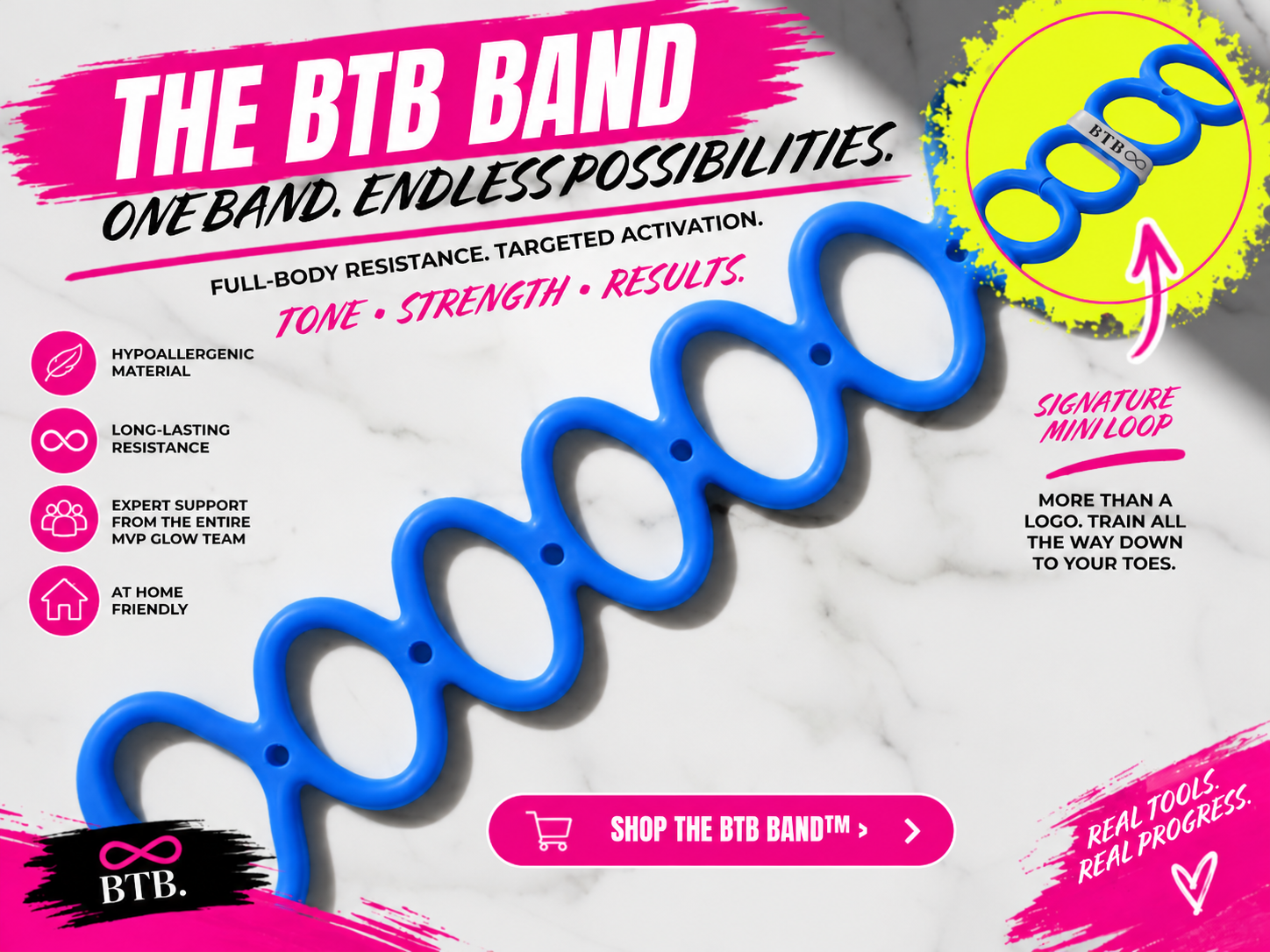
If you want the exact band, the Original BTB Band is skin-friendly and latex-free, with multiple handles for different tension levels. The BTB Workout Starter Set bundles a band with the accessories you need to begin.
Watch out: a band that snaps mid-pull can sting. Check yours before every session and replace anything worn.
The Full Body Workout Resistance Band Plan: Minute by Minute
Minute 0:00-1:00, Warm-up (1 minute): march in place, roll your shoulders, do 10 gentle pull-aparts. Keep the band light and the movements smooth.
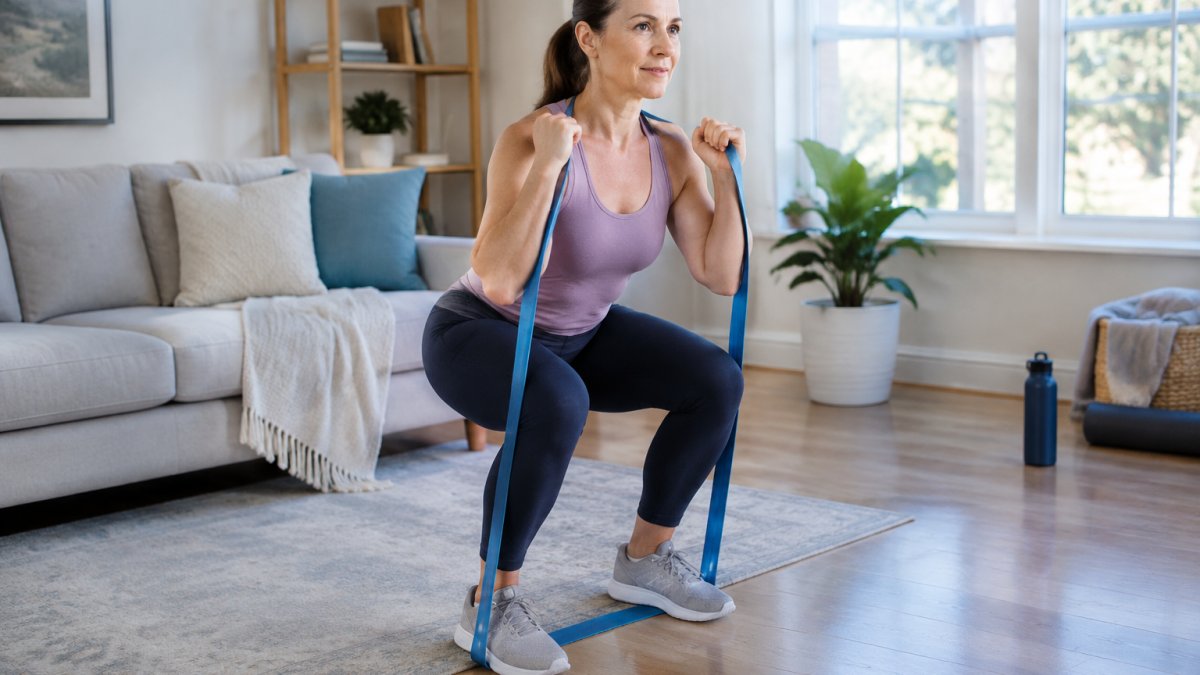
Minutes 1:00-9:00, Circuit (8 minutes total): two rounds of four exercises, each 40 seconds work / 20 seconds rest. That's 8 intervals × 60 seconds = 480 seconds = 8 minutes.
Circuit (8 minutes): two rounds of four exercises, each 40 seconds work / 20 seconds rest:
- Squat with band under feet
- Pull-apart
- Split squat (each leg, 20 seconds per leg)
- Shoulder press
That is 2 rounds × 4 exercises × 60 seconds = 480 seconds = 8 minutes.
Cool-down (1 minute): slow shoulder stretch and standing hamstring stretch.
The four-exercise circuit works the shoulders, back, glutes, and legs in one short block.
Watch out: the most common mistake is miscounting rounds and rest, which can stretch the session past ten minutes. Use a timer that beeps every 40 and 20 seconds, and stop at exactly 8 minutes of circuit time regardless of where you are in a round.
Here is how the ten minutes break down, minute by minute.
| Phase | Time | What to do |
|---|---|---|
| Warm-up | 1 minute | March in place, roll shoulders, 10 gentle pull-aparts |
| Circuit | 8 minutes | Two rounds of four exercises, 40 seconds work / 20 seconds rest |
| Cool-down | 1 minute | Slow shoulder stretch and standing hamstring stretch |
| Circuit exercises | 4 moves | Squat, pull-apart, split squat, shoulder press |
| Split squat | 20 seconds per leg | Each leg within the 40-second interval |
Time breakdown of a 10-minute resistance band workout
A 10 Minute Resistance Band Workout for Beginners
The 10 minute resistance band workout for beginners uses the same circuit with slower reps and lighter tension. Start with two rounds, and use progressions, regressions, and substitutions to adapt each move to your current ability.
Progressions and Regressions
A progression makes an exercise harder; a regression makes it easier. Use these to scale the six moves:
- Squat: Regression, sit back to a chair and stand up. Progression, add a pause at the bottom or hold the band at shoulder height instead of under feet.
- Pull-apart: Regression, use a lighter band and pull only to shoulder width. Progression, use a heavier band or slow the return to three seconds.
- Split squat: Regression, hold onto a wall for balance and reduce range. Progression, elevate the back foot or add a pause at the bottom.
- Shoulder press: Regression, press one arm at a time or use a lighter band. Progression, press both arms overhead with a heavier band.
- Bicep curl: Regression, curl one arm at a time. Progression, curl both arms with a heavier band or add a slow lowering phase.
- Glute bridge: Regression, do the bridge without the mini band. Progression, add a band around the thighs and press knees out at the top.
Substitutions for Limited Mobility or Discomfort
If a move causes joint pain, swap it rather than push through. Sharp pain is a signal to stop. Common substitutions:
- Knee pain during squats: replace with glute bridges or seated band leg extensions.
- Shoulder discomfort during presses: replace with band pull-aparts or external rotations.
- Low back strain during glute bridges: reduce range and focus on squeezing glutes, or do a standing hip hinge with the band.
- Balance issues during split squats: hold a chair or wall, or replace with seated band leg presses.
Form Cues and Common Mistakes
Form is where beginners lose results. These cues fix the four mistakes we see most.
- Squat: knees track over toes, chest tall, sit back like a chair. Watch out: letting knees cave inward, push them out slightly.
- Pull-apart: keep shoulders down, squeeze shoulder blades together. Watch out: shrugging shoulders up toward ears, keep them relaxed.
- Split squat: front knee stays behind toes, torso upright. Watch out: leaning forward, keep chest proud.
- Shoulder press: press up without arching your lower back. Watch out: flaring ribs, brace your core.
The biggest mistake is letting the band pull you back fast. The return is half the exercise. Control it. Another common slip: holding your breath. Breathe out on the effort.
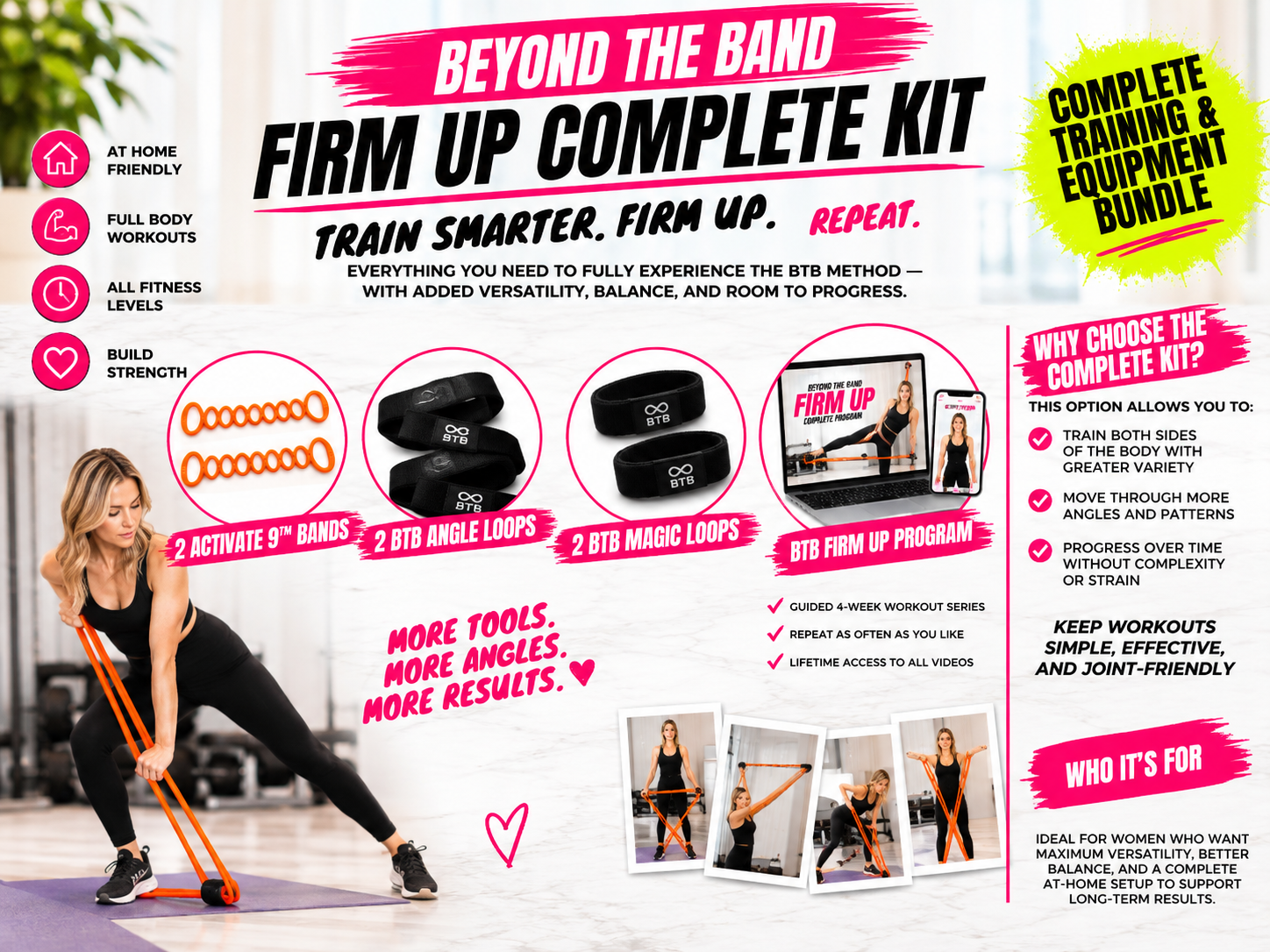
Beginners should drop the rep count and slow the tempo. If you want the full setup with guided sessions, the Firm Up Complete Exercise Kit includes 30 days of workouts so you can practice each move correctly.
Your 10 Minute Resistance Band Workout at Home
A 10 minute resistance band workout at home needs almost no space. A clear patch of floor and one band is enough. No gym, no commute, no equipment beyond the band.
Bands are also easy to pack for travel.
Do it while dinner cooks. Do it before your first call. The point is that it happens.
If your joints feel stiff, keep the range smaller and the tension lighter.
Get the 10 Minute Resistance Band Workout PDF and Stick With It
A 10 minute resistance band workout PDF can help because you don't have to decide what to do each time.
Print it. Stick it on the fridge. Tick off each session.
That said, a PDF is only a list. The BTB Firm Up 30 Day Video Program gives you a 4-week plan of 10-minute follow-along workouts that progress each week, with lifetime access.
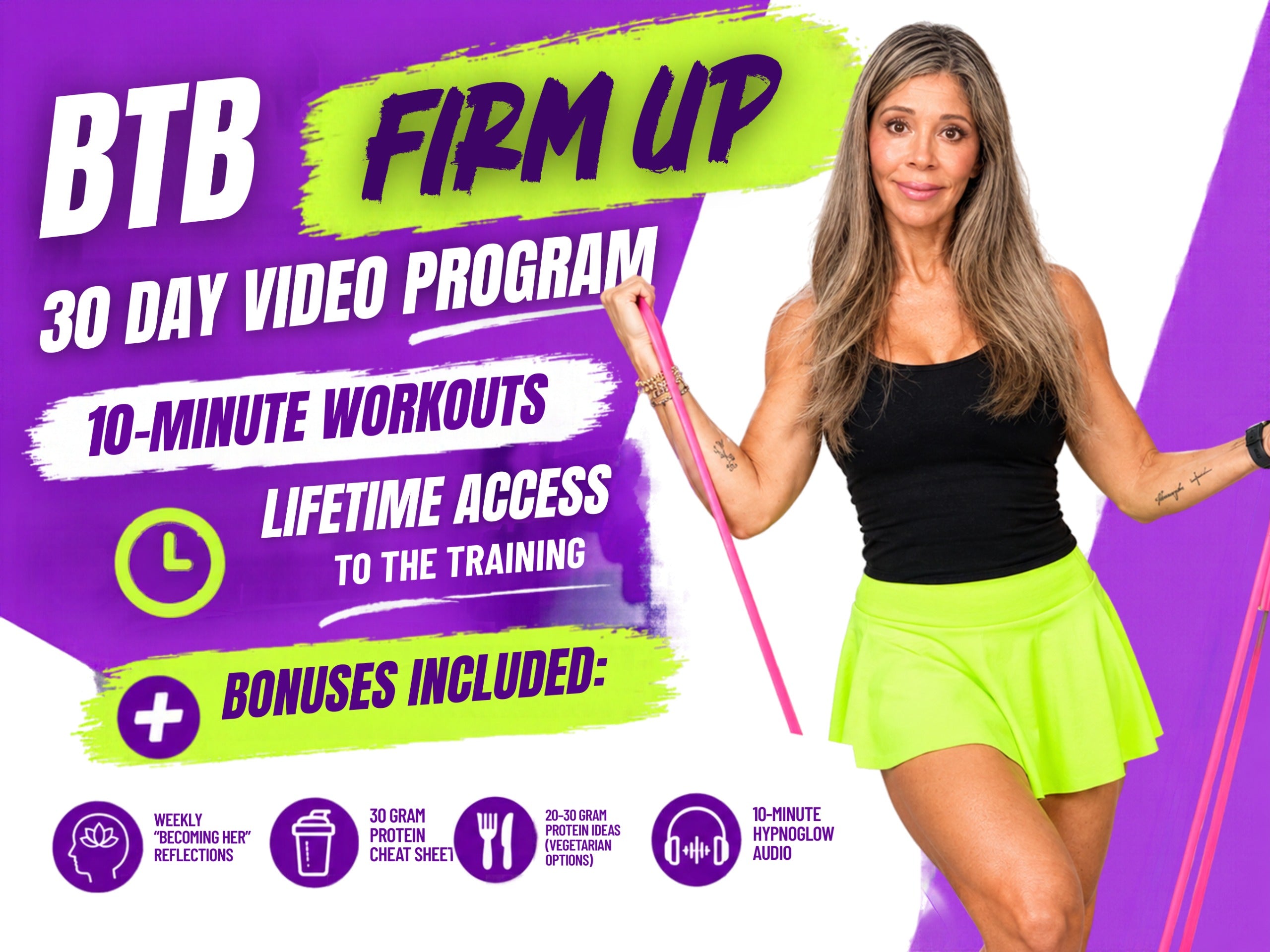
It also includes weekly "Becoming Her" reflections, a 30-gram protein cheat sheet, and a 10-minute HypnoGlow audio to reset the mind and release stress.
When you're ready to keep going after the PDF, the Workouts Only collection gives you sessions to repeat.
Start Your First 10-Minute Band Session Today
Ten minutes is short enough to do today and long enough to matter over time. Pick your band, clear a patch of floor, and run the six-move circuit once. That's your first session done.
Consistency is the whole game. Short sessions you repeat beat long ones you dread.
MVP-glow's programs are designed for women over 40 who need fitness to fit a full life. Our 10-minute workouts, mindset bonuses, and protein guides are built to help you tighten, tone, and stay consistent.
Frequently Asked Questions
Do 10-minute workouts actually work?
Ten-minute sessions can be a practical option when they are structured and repeated consistently. A focused resistance band workout that alternates upper and lower body moves with short rest intervals keeps the heart rate up and loads the muscles enough to build strength. The catch is frequency: two to four short sessions a week beats one long session you skip.
Can you get a full-body workout with resistance bands in 10 minutes?
Yes. A full body workout resistance band circuit can hit chest, back, shoulders, arms, glutes, legs and core in ten minutes if you pick compound movements. Pair a squat with a shoulder press, a split squat with a row, and finish with a pull-apart and a deadlift variation. Two rounds of five exercises at 40 seconds work and 20 seconds rest covers every major muscle group without needing heavy equipment.
How often should beginners do resistance band workouts?
Start with two or three sessions a week and leave a rest day between them so muscles recover. Beginners should use a lighter band and focus on controlled movement rather than speed. Once the last few reps feel easy, add a round or move to a stronger band. If joints feel sore the next day, drop back a level rather than pushing through.
Are resistance bands gentle enough for stiff or sore joints?
Keep the range comfortable, avoid locking out, and stop any move that causes sharp pain. A loop band with multiple handles lets you adjust tension mid-move, which helps when one side is stiffer than the other.
